Lessons from Ukraine
How free market principles win wars

Rheinmetall’s CEO recently questioned the Ukrainian arms industry’s claim to have revolutionised defence production, stating “What is the innovation of Ukraine?” adding that “they don’t have some technological breakthrough.”
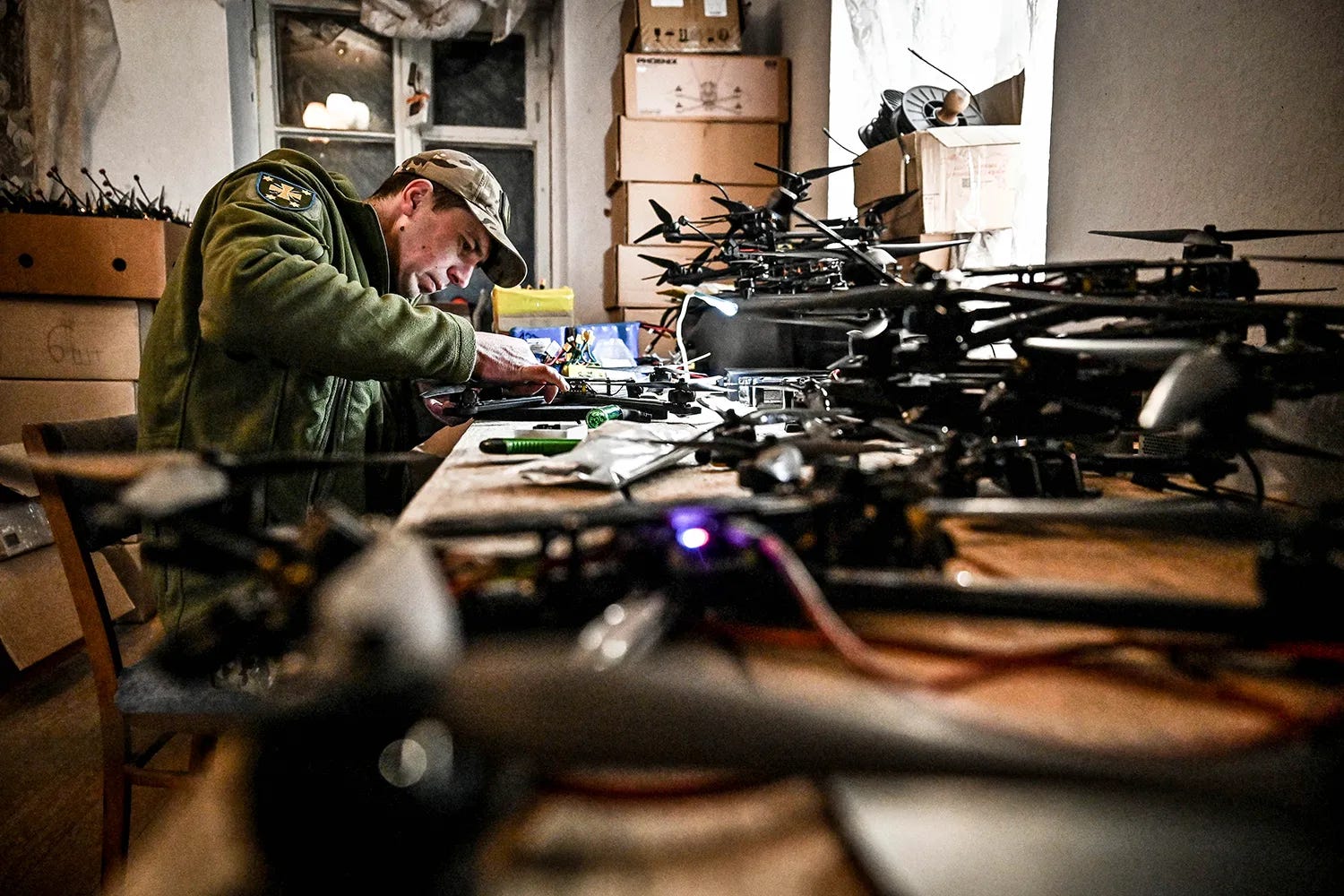
Ukraine’s key innovation has not simply been some technological ‘wonder-weapon’, but in their revolutionary procurement methods, which have helped create the most dynamic and fast-moving defence industry on the planet. Russia can eventually replicate each Ukrainian innovation, e.g. cheap mass-produced drones, however, by that time Ukraine has already moved on to the next.
Given the recent resignation of both the Defence Secretary and the Minister for the Armed Forces, in a spat over UK defence spending plans we urgently need to learn from Ukraine. Al Carns’ resignation letter specifically called out the Ukraine war as demonstrating that “The character of conflict is changing faster than our procurement can keep up.”
Britain needs to spend more on defence, but more money routed through our current slow and inefficient procurement system will not automatically produce meaningful results. Who can forget the waste of £6.3bn on developing Ajax armoured vehicles which still leave their operators vomiting due to design flaws?
Building a start-up ecosystem
Ukraine has embraced the private sector, building a start-up ecosystem which has delivered impressive results. Brave1, the government-backed defence-tech cluster, has acted as an angel investor: providing grants, setting open competitions, linking start-ups with military units, and coordinating private industry with battlefield demand. Launched by the Ministry of Digital Transformation it has enabled a deep network of collaboration between the government, private industry, investors, and the military. Defence Tech Valley 2025, a Brave1 led defence investment summit had over 5,000 attendees.
This has been accelerated by initiatives such as Diia.City, Ukraine’s streamlined legal framework for IT companies, including drone manufacturers. It offers lower payroll taxes with just 5% personal income tax, flexible hiring rules and a 9% exit capital tax as an alternative to traditional corporate income tax. Thanks to these measures Ukraine has gone from a defence industry dominated by a single post-Soviet state-owned enterprise, Ukroboronprom, to having over 500 drone manufacturers alone.
Their trust in private initiative is so high that the government has authorised 30 Ukrainian companies to create their own private air defence units to protect key industrial sites. Ukraine has put into practice something that the British state all too often seems to forget, if you want innovation, you must make it easier for innovators to build.
Letting front line units drive procurement
Markets are discovery mechanisms. In war adaptation and discovery are a matter of survival.
Ukraine began the war with a traditional military procurement system. Large, standardised orders from suppliers chosen by the defence ministry with no room for adjustment to individual circumstances. Ukraine’s key innovation was to decentralise military acquisition, placing the funding and decision-making power in the hands of military commanders on the front lines.
Enabled by their earlier implementation of a public electronic procurement system Prozorro, groundbreaking in its own right by allowing greater price competition and transparency, Ukraine launched DOT-Chain Defence in July 2025. Perhaps best described as an ‘Amazon’ for weapons systems, Military units independently select, order, and reserve the necessary equipment, see delivery timelines, leave feedback, and receive quick responses. The system is designed to eliminate unnecessary bureaucracy and allow frontline brigades to order in exactly the resources they need at any given time with minimal delay. If a product is low-quality individual units will cease to order it as soon as battlefield conditions expose its flaws, providing rapid feedback to manufacturers to improve their products.
The e-points system is another recent deployment. A unit carries out a combat mission and uploads video proof of its achievements, targets destroyed etc., to the DELTA combat and control system. The unit is then awarded e-points at the end of the month, a virtual currency which it can use to purchase the weapons systems of its choice.
By introducing clear incentives at every step of the process, combat units are motivated to provide results, manufacturers to improve quality and the Ukrainian military machine becomes ever more effective.
Openness, not autarky
Instead of retreating into autarky Ukraine has embraced trade and cooperation in its military industry. The “Test in Ukraine” programme has invited foreign arms manufacturers to send weapon prototypes for live battlefield testing against Russian forces. This builds goodwill, helps foreign partners innovate and gives Ukraine advance reports on the effectiveness of new weapons systems.
Through “Build In Ukraine” the government has streamlined foreign defence companies’ construction of factories in Ukraine whilst “Build with Ukraine” establishes Ukrainian joint arms production in allied territory.
Ukraine has even announced that it will allow the export of surplus domestically produced weapons systems in return for security cooperation, taking advantage of foreign demand to help scale its defence industry.
In its embrace of trade and international cooperation Ukraine has made it clear that it understands the benefits of comparative advantage and the gains to specialisation.
The lesson for Britain
Ukraine’s embrace of competition, open information, price signals and decentralisation in their military supply chain is unprecedented and has yielded impressive results.
The British government should take heed of these clear lessons in what is necessary for a country to compete in a modern war. Direct control and centralisation will not lead to a military capable of adapting to rapid technological progress in weapons manufacturing.
The liberal principles of trade, rewarding innovation, and decentralised decision-making enabled by markets have proven their worth in Ukraine in life-and-death circumstances. They are worth consideration rather than out-of-hand dismissal.